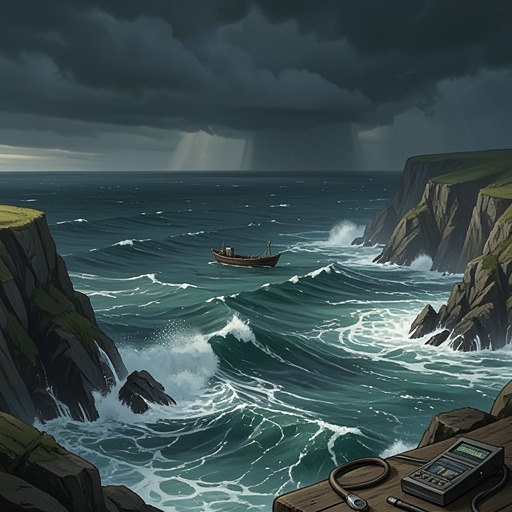
The ocean is a wilderness reaching around the globe
The WhaleThe ocean is a wilderness reaching around the globe is a compact statement of the book’s governing perspective: the sea is not empty space between human destinations, but a vast and active world with its own scale, rhythms, and consequences. The phrase holds together two truths that the narrative repeatedly places in tension. The ocean has remained wild across the rise and fall of civilizations; yet human industries have reached into it, altered its life, and helped drive species toward disappearance.
Thoreau’s proposition
The phrase comes from Henry David Thoreau’s reflection on the ocean’s antiquity. Unlike the land, whose past people imagine through visible changes, the sea seems to offer no comparable record of how it looked a thousand years ago. Its apparent sameness is not evidence of tameness: it has remained wild and unfathomable, washing against city wharves and seaside gardens as readily as against remote shores. The phrase makes wilderness less a distant territory than a condition present at civilization’s edge.
The book enlarges that proposition beyond an image of remoteness. The sea covers more than three-quarters of the Earth, and its smallest organisms supply every other breath of oxygen people take. Tides and shores shape human movement and borders more insistently than treaties or governments. Against those material dependencies, the habit of treating the ocean as mere distance to be crossed appears less like mastery than a failure of attention.
A world in motion
That wilderness is not static. Under close observation, the water becomes a continuous drama: it can rise dozens of feet, lie almost glass-still, reflect the sky so completely that sea and air seem joined, and take away as readily as it gives. Its changing surface makes visible only a fraction of what is happening; the book imagines the sea as an all-engulfing living system even as daily life reduces it to a glimpse from a road or aircraft. In one such contrast, a grey autumn afternoon on a sea wall gives way to the improbability that giant animals once broke the water there.
The seasonal journey of humpbacks gives this scale a route and a timetable. After six months fasting and mating in the Caribbean, they travel north on an annual migration of up to eight thousand miles, following ancient routes and signs invisible to people. Off the Gulf of Maine, the Gulf Stream meets cold Labrador currents; the resulting upwelling brings nutrients from the ocean floor and sets a food chain in motion. The whales feed on sand lances and herring, while the seasonal abundance supports their return. Less than two hours’ sail from a major American city, animals weighing fifty tons launch themselves from the sea. Wilderness here is not lifeless emptiness but a system of movement, nourishment, and play.
The Azores offer another measure of the difference between the visible map and the ocean’s underlying geography. The nine islands lie amid the Atlantic, but represent seamounts rising from an immense submerged spine. Their position crosses the Eurasian, African, and American plates; Pico, the youngest island, appeared only a quarter of a million years ago and still has an active volcano. The ocean’s surface can conceal geological divisions and forces on a scale that ordinary maps barely suggest.
The wilderness under extraction
The book does not treat wildness as immunity from human action. In 1859 Edwin L. Drake drilled for oil at Titusville, Pennsylvania. The crude oil’s spouting from the ground marked a turning point for the sperm-whale fishery, as petroleum began to replace one of the uses that had sustained it. A decade earlier, domestic gas had initially helped increase demand for whale oil by intensifying the appetite for bright light; changing energy sources could redirect exploitation rather than simply end it.
Technology opened new targets. On Christmas Eve 1868, Sven Foyn recorded gratitude for the grenade harpoon he had patented, a weapon designed to explode in a whale’s head. Harpoon guns had existed earlier, but Foyn’s invention enabled Norwegian whalers to pursue fast rorquals, including blue whales and fin whales. The book describes the consequence plainly: once sighted, a whale could be treated as effectively doomed. As sperm and right whales became too depleted to pursue profitably, hunting shifted to other species and grounds. The ocean’s apparent inexhaustibility thus concealed a commercial logic of moving on whenever a population had been diminished.
In 1904, armed Norwegian and British steamships opened Antarctic grounds to supply whale products for the manufacture of nitroglycerine. During the two world wars, fifty thousand whales died; their oil and bodies served industries that enabled further human destruction. By 1918, the South Atlantic humpback population had been driven to extinction. The phrase’s global wilderness is therefore not a claim that the sea stands outside history. It is a warning that industrial and military histories have entered the ocean, while the animals bear consequences far from the cities and battlefields that benefit from their exploitation.
Knowledge, society, and loss
The sea is also a human world of work and unequal conditions. A replica whale ship at New Bedford makes the connection between maritime commerce and social history tangible: its constricted lower decks recall the slave ships built to transport people, though the whale ship carried the harvest of dead animals. The likeness does not make the two forms of transport identical; it draws attention to the human labor and confinement behind an industry centered on the whale.
Frederick Douglass arrived in New Bedford in 1838 after escaping slavery from Baltimore dressed as a sailor. For four years he worked at demanding jobs including rolling casks, stowing ships, and sawing wood. The book connects the shipyard to education and opportunity, while also describing New Bedford as a port built by people from many places. By the second quarter of the nineteenth century, one in twenty residents was Black; neighborhoods included Azorean and Cape Verdean communities, and a dozen languages could be heard in the town. The ocean connected these lives through labor and migration, but the ships and industries it supported also preserved divisions: below deck, bunks were segregated, and working conditions grew so harsh that by the end of the century only men of color could be persuaded to sign on.
The book’s account of whales as social beings makes the losses more than a matter of numbers. Research described by Hal Whitehead identifies learned practices passed between generations, distinctive social groups, and different repertoires of clicks. Hunting may have damaged these societies by removing matriarchs who carried essential knowledge, as well as large breeding males. At the same time, the Yangtze River dolphin was declared extinct while the book was being written. The account warns that, by the end of the century, half of animal species, including right whales of Cape Cod Bay, might follow. These are presented as a grave projection, not a completed outcome; the extinction already recorded gives the warning its force.
The phrase finally insists on a limit to human knowledge as well as human power. A sea can be measured in routes, currents, and catches without becoming fully known; a whale can be studied without being reduced to what it yields. To call the ocean a wilderness reaching around the globe is to recognize both its enduring independence and the urgency of protecting a world whose complexity human exploitation has already begun to erase.